
A polished demo can make a service look universal: one prompt, one connection, one clean answer. Real use may involve shared devices, intermittent connectivity, several working languages, or a paper step the demo never showed. Across African markets and communities, conditions differ widely; the useful question is which conditions shape this particular problem.
Start with a local job
Describe the job in the words of the people doing it, not in the language of a product category. A farmer, a clinic administrator, and a small-business owner may each need help finding or organizing information, but their decisions, constraints, and tolerance for error are not interchangeable. A local partner can help reveal what an outside design team has missed.
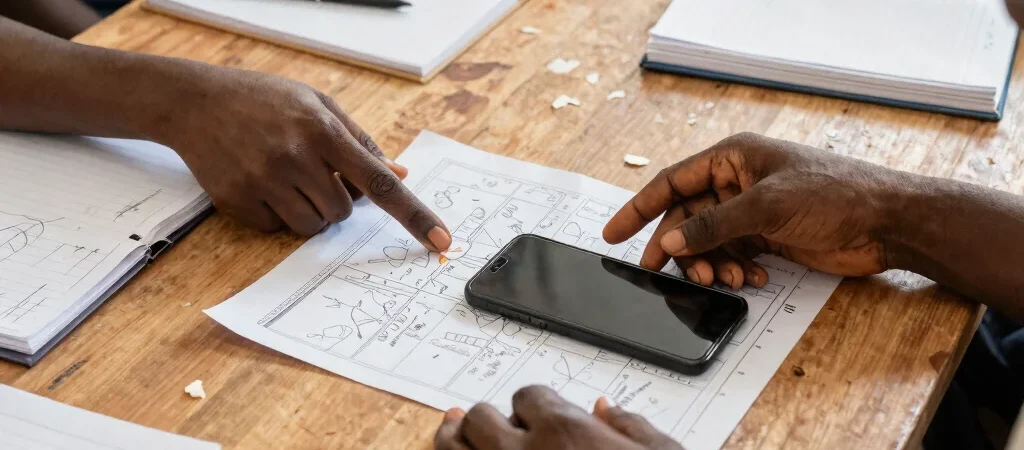
Spend time with the existing process before proposing an AI feature. Notice where people switch between voice notes, messaging, forms, and face-to-face clarification, and ask what makes each step useful. The objective is not to replace familiar work simply because a new tool can.
Treat constraints as design inputs
Language support involves more than translating a button: it can affect how people phrase questions, understand a response, and correct a misunderstanding. Connectivity and device access can determine whether a feature should work offline, use less data, or offer a non-digital fallback. These choices are product decisions, not last-minute adaptations.
Consider who maintains the service, where information is stored, and how a person gets help when something goes wrong. The answers depend on the specific country, sector, and community, so broad regional assumptions are a poor substitute for local research. Build the questions into discovery before committing to the technical design.
Test value beyond launch
A strong early test asks whether the tool fits the existing task, whether people can verify important outputs, and whether the intended users actually choose to return to it. Include the people who will support and maintain the service, not only its first users. Their experience often surfaces costs and dependencies a demo leaves out.
African opportunities are not a single market waiting for a ready-made solution. They are specific problems, expertise, relationships, and possibilities that deserve to shape what gets built from the start. Begin with a local job, test in the conditions where it happens, and let the evidence—not the demo—decide what comes next.